Just ten years ago, if I had told you that Vin Diesel would be the
highest grossing actor at the box office, the President of the United States would be Donald Trump and running the country by doing something called tweeting while taking a dump and that the NFL would be losing popularity because a few players chose to kneel during the national anthem you would have looked at me as though I'd turned up to a black tie event in a crotchless mankini and a white tie. Our societal obsession with all three of these themes will probably boot the final score of Sunday's Super Bowl LII to page three in favor of the TV ratings which will be used to bash either Kaepernick or Trump depending not on the actual figures but the biased interpretation most will be sure to read.
Welcome to the
Idiocracy, packaged and sold to you as a
meritocracy. We may have arrived half a millennium early, but that's not surprising considering capitalism's economic imperative to constantly speed things up. With a little help from identity politics, this past year saw football become an even sharper reflection of society today, but at least we've got a game to watch Sunday as the New England Patriots face the Philadelphia Eagles in Minneapolis. As every year in this space, that means it's time to look back on the year that was in football and by association, America, ever since the Falcons blew a 25 point lead with 17 minutes left in Super Bowl LI before getting to the prediction for LII. Buckle up, this could be a long and windy road!
It's cliché to say that injuries are part of the game, but it was clear from the get go that this year was, in fact, different. From David Johnson being lost in week one for the season to Steelers linebacker Ryan Shazier's gruesome, life altering spinal injury, this year's injury report seemed both longer and more star studded than ever before. It wouldn't be a stretch to say that the league's best running back, the aforementioned Johnson, best quarterback, Aaron Rogers, best wide receiver, Odell Beckham Jr, best offensive lineman, Joe Thomas (and his
10,363-snap streak), and best defensive player, J.J. Watt, all missed most of the year due to injury.
Add to the list the leading MVP candidate at the time of his injury, Carson Wentz, the league's most exciting rookie QB, DeShaun Watson, Andrew Luck, Sam Bradford, Ryan Tannehill and Carson Palmer and that's just starting QBs. Running backs besides Johnson were of course well represented with the likes of Dalvin Cook and Spencer Ware missing all or most of the season. Beckham was joined by WRs Julian Edelman and Allen Robinson, more offensive lineman than you can shake a stick at shared
IR space with Thomas and of course defensive players were also dropping like flies, from Eric Berry to Kam Chancellor and Richard Sherman.
Sadly, at this point it's impossible to avoid the elephant in the room, CTE, chronic traumatic encephalopathy, a degenerative neurological disease
caused by repeated head trauma and only diagnosable with certainty in
post-mortem examinations. Ruptured achilles, torn ACLs and broken collarbones heal, but alas, the brain doesn't, and getting it bashed week in, week out is literally killing people performing for our pleasure. Watching Colts tight end Brandon Williams
go limp or Travis Kelce
concussed are the visible manifestations, but it's more likely the hundreds of sub-concussive hits which aren't replayed from every angle that are the basis for the fact that in a
recent study 110 of 111 deceased NFL players' brains exhibited CTE.
Knowing they've got a PR nightmare on their hands, in much the same way as the tobacco and oil industries created confusion about the links between their products and, well, killing humanity, the NFL's boardroom geniuses reaction has evolved from denial to deceit to damage control. Yet anyone watching how the so-called 'concussion protocol' plays out in practice would have to put paid to any belief that it is in any way effective, along the lines of putting filters on cigarettes or
switching to diesel. Tom Savage's return to play after an obvious
seizure or Russell Wilson's medical tent evaluation would
like a word. What the hell is that stupid looking
medical tent anyway? Now we've even learned that concussions, though playing a role, aren't even the root cause of the disease, it's simply about the
accumulation of hits to the head.
Sure, this disease has led some to reconsider
allowing their children to play football, but it couldn't have anything to do with the NFL's ratings decline, could it? By happenstance, the other profession most at risk of developing
CTE is soldiers. I bring up the coincidence as television revolutionized the way America was sold violence, either war packaged for nightly news reports and eventually as fodder for 24 hour news filler, or football on Sunday afternoon, then Monday, Thursday and Sunday night brain bashing ratings bonanzas. The constant barrage of brutality makes it all but impossible to discern the pro-war propaganda let alone discriminate between GIs and players as their images overlap, veterans of wars and gridiron switch spots as the camera flicks from soldier presenting the colors, to defensive blitzes, from F-16 flyovers, to quarterbacks throwing bombs while Fox, CBS, NBC, ESPN and the NFL network celebrate their role in making it possible for the service men and women sacrificing for our freedumbs overseas to enjoy the game.

The Cleveland Browns became just the second team to finish 0-16 after
the 2008 Detroit Lions. For lovers of schadenfreude, here are
the Browns lowlights
but consider yourself warned, they're tough to watch. What other team
could begin 2017 losing to a Landry Jones led Steelers team and
close out the year the same way yet retain Hugh Jackson as coach despite a now 1-31
record. Their #1 draft pick, DE Myles Garrett started out the year hurt and that was the high point, while the low is captured here right after Corey Coleman dropped an easy catch that could've put them in position to beat the Steelers in week 17. They traded out of position to draft Carson Wentz a couple years ago, did the same on DeShaun Watson last year and couldn't even get the fax machine to work to finalize a
trade for AJ McCarron at the trade deadline. In Cleveland, all this means it's
time for a parade. Well, they do have the #1 and #4 picks next year. They were outscored by
176 points over the course of the season and had the worst
turnover differential (-28) since the 2000 Chargers. Does that make DeShone Kizer the
new Ryan Leaf?
The
Browns, though exceptional, weren't the only bad team this year. In fact, there was a logjam of awful crowding behind them. The Andrew Luckless Colts were every bit as bad
finishing 4-12 and getting their coach fired too. After losing
Watson and Watt, the Texans fell off a cliff and finished with the
same record. The biggest surprise in the bottom tier was the
Denver Broncos as I can't remember a Broncos team ever being as straight up
awful as this team was. Joining them at 5-11 were the Jets, Bears and
Buccaneers where, respectively, Josh McCown had to play QB because no
one else could (and did well enough to get his coach Todd Bowles a
two year extension), #2 pick Mitch(ell) Trubisky wasn't the biggest problem, but his lack of targets and a seemingly done John Fox were,
and Jameis Winston tried to
eat a W instead of, you know, winning. The
Odelless Giants were so bad that Eli Manning got benched putting an end to his league
leading
consecutive starts streak at 210; problem was, it wasn't Eli's fault, they were just horrible, getting coach McAdoo fired before the
season even ended.
Speaking of turning tragedy into melodrama, if we're talking about the 2017 NFL season, we need to talk about the Ezekiel Elliott suspension soap opera. In the attention economy where clicks and eyeballs drive revenue, the NFL, like every other industry, no longer bothers with solving problems, but instead exacerbating, extending and monetizing them. For those living on Mars or with medium-term memory problems, Elliott was suspended prior to the regular season for six games after a year long league investigation into domestic violence allegations from the summer of 2016. His former girlfriend filed a police report but he was never charged with a crime. However, the NFL has its own parallel system of justice ruled over by one man, Roger Goodell, judge, jury and executioner.
Still feeling the sting of the
Ray Rice scandal, Roger was likely eager to show the world the NFL had mended its ways on the domestic violence issue; evidence shmevidence when you've got a ticket to headline news. It's hard to say if they foresaw the fallout, but it did manage to stay in the news cycle a lot longer than just six weeks as what ensued was a legal roller coaster reminiscent of deflategate that saw Elliott suspended and reinstated on alternating days for what seemed like an eternity. In the end, Elliott wound up missing Cowboys' games nine through fourteen. Yep, pink gloves, shoes and towels in October and a wall mounted
trophy in Ezekiel Elliott, the Dallas Cowboys running back who led the
league in rushing as a rookie in 2016, to prove how much he and the NFL
care, I mean really care, about women.
Tyreek Hill.
Ray McDonald.
Josh Brown.
Greg Hardy.
Joe Mixon. Hypocrisy, thy name is NFL.
After beginning the season 0-9, the San Francisco 49ers went on the finish 6-10. Prior to this, no team had ever amassed
more than three
wins after such a horrific start. At one point, it had been
over 700 days that they had beaten anyone not called the Rams. Yet they ended the regular season
with the longest winning streak in the NFL. Guess, it might've had something to do with the Jimmy Garoppolo, just call him Jimmy GQ, trade. The Dolphins, who brought in
smokin' Jay Cutler to replace the injured Tannehill and the Raiders, who
lured Beast Mode out of retirement, finished with the same records but
not the same optimism as the Niners. It was a lost season in Washington which will exchange their double franchise tagged QB for
Alex Smith next year, and it'll be a cold off-season in Green Bay after
half a year without Rodgers; both ended up at 7-9. Ditto for the Bengals
whose only achievement was helping the Bills into the playoffs for the
first time since 1999 and snapping the longest drought in major
professional North American sports. Yes,
this is happiness.
Despite those Bengals somehow
bringing Marvin Lewis back
again next year the head coaching carousel was in full swing by year's
end as Cardinals coach Bruce Arians retired after finishing as the only
.500 team. The Raiders' Del Rio, Bears' Fox, the Lions' Caldwell and
Colts' Pagano all found pink slips waiting for them to start the new
year. I
feel worst for Jim Caldwell, fired despite compiling the
best record of any Detroit Lions coach in the Super Bowl era and delivering the
first back to back winning seasons since 1993-95. Ah, but that
playoff winning percentage.
The Chargers really moved from San Diego to LA becoming the only team to play 16 road
games, seriously, fuck Dean Spanos, but even
more surprisingly, Keenan Allen stayed healthy, had a great year
and almost dragged his team into the playoffs. The Ravens joined both
at 9-7 on the strength of a defense that became just the fifth team in
30 years to post
three shutouts in a season.
Good thing Goodell's contract was up for renewal so something could be done to fix what's ailing the league. Wait. What's that? It's actually in his job description to do stuff that makes him hated to distract attention from the owners? Is that why they
voted unanimously in May to authorize the Compensation Committee to enter in to
negotiations and offer him an extension of his contract
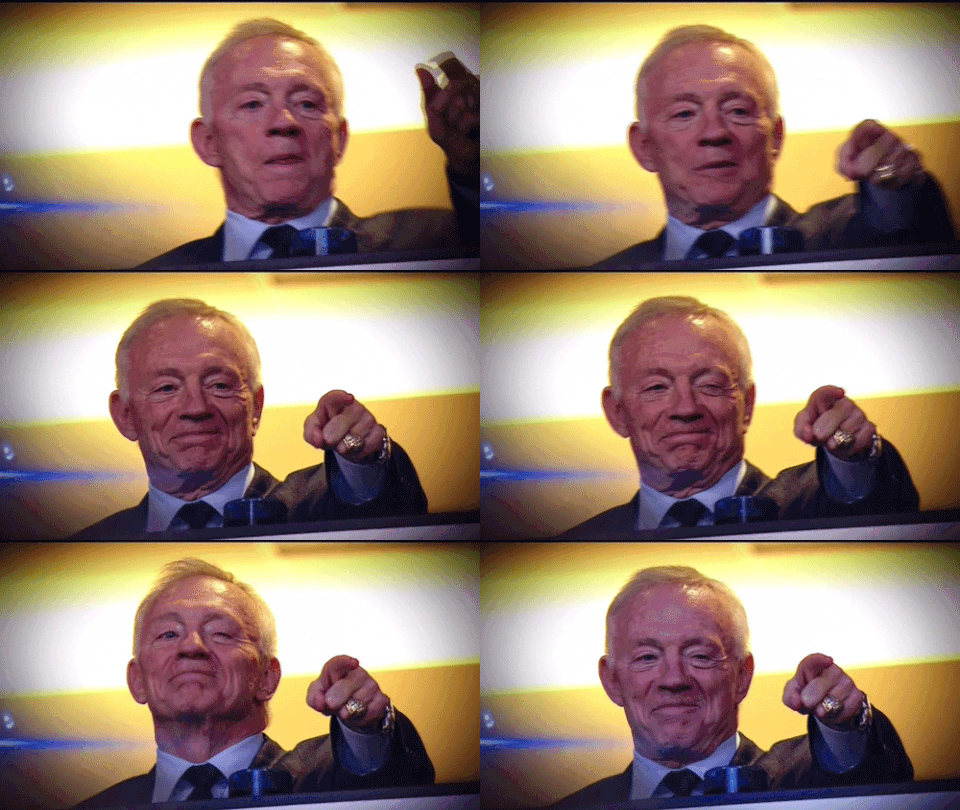
through 2024? Well, one owner changed his mind, shocker, the owner of Elliott's Cowboys, Jerry Jones. Seems he was happy enough to watch Roger, well, roger other teams such as the Patriots during deflategate, but not so much when he was the victim. Despite Jones' ultimately
failed coup attempt, his rabble-rousing did manage to wake the public to Goodell's
contract demands: $50 million a year, lifetime use of a private jet and lifetime health insurance for his entire family. Well, they signed a deal, but we don't get to find out what's in it as since the NFL lost (or dropped depending how you look at it) its federal tax exemption in 2015, his salary is no longer public. We do know he was paid more than $205 million between 2008 and 2015 and
reports peg the new deal at $200 million for five years, so I'm guessing he got the jet and insurance.
Here's where things get weird, America-specific weird. No, not because people are pissed off, but why they're pissed. It's not that, as the owner's memo revealing the deal stated, it is "fully consistent with 'market' compensation". A market that the public has been convinced has been guided by an invisible hand to inflate the ratio of CEO-to-average worker pay
over a 1,000%, from around 20-to-1 in 1950 to over 300-to-1 today. Nor that, thanks to an awful CBA signed by the players union with the league, the best running back of our generation will likely be
franchise tagged again, meaning he will "only" be paid the average of the five highest running backs and be left without a multi-year deal, meaning if he gets injured, he'll have no salary guarantee. Nor that Goodell's family will have better lifetime health insurance than not only pretty much every American, but also former NFL players, who have a slightly higher risk of debilitating injury and related health problems than Roger's wife Jane. No, they're mad as hell because
FOX News tell them it "has never been the American way to treat customers like the enemy", and he was in charge while the "NFL burned in flames as American patriots refused to watch games where players protested our sacred symbols". Wait, I'm getting ahead of myself, the Donald and his
anger stick will have to wait until after we get through the last two non-playoff teams, the Seahawks and Cowboys.
It felt as though the Shithawks' window closed a little, but
Russell Wilson played lights out most of the year; we also witnessed the end of the CenturyLink mystique as they went
4-4 at home. Here's a
crazier stat. Total Seahawks rush attempts inside opponent 10 yard line -
Russell Wilson: 3 carries for 3 yards and 2 touchdowns; all other Seahawks: 20 carries, -3 yards, 0 touchdowns, 0 first
downs. Including passing and rushing yards, Wilson finished the
season accounting for 81.5% of all Seattle yards from scrimmage (bizarrely,
second all-time
behind Jon Kitna's 2006 season with Detroit at 81.8%). The Cowboys,
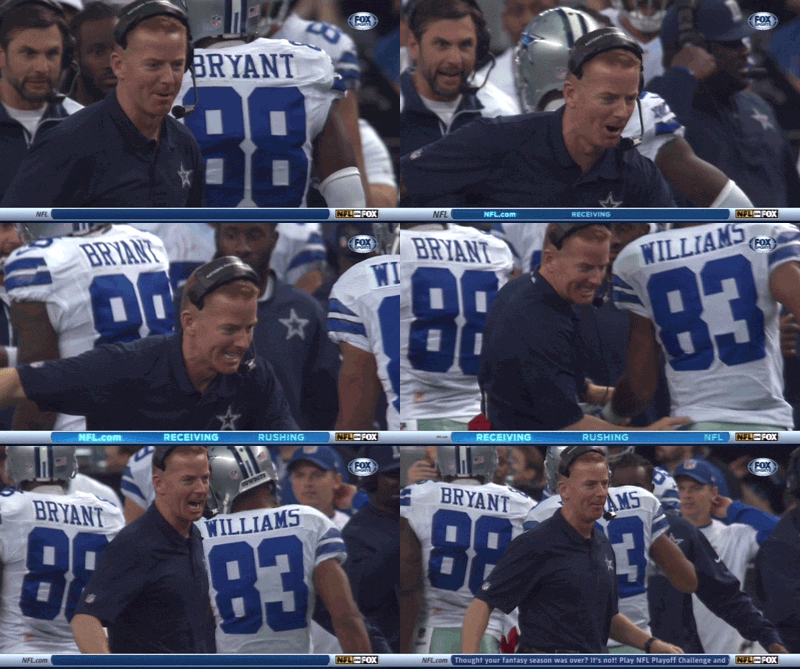
meanwhile, couldn't get over the Elliott drama, watched Romolessly as
Dak regressed, were overly reliant on Sean Lee and Tyron Smith being
healthy, which they not always were, and seem to be stuck with Jason
Garrett's
uselessness cuz he's
Jerry's guy despite seemingly never
having heard the term 'half-time adjustments'.
The
comeback player of the year wasn't even on the field but in the
broadcast booth as Tony Romo took up the mic for CBS this year and won
over football fans across the country, even Philadelphia. While the loss
of Jon Gruden back to the coaching ranks might sting for a bit, Romo
more than made up for it with his
enthusiastic, scholastic and
prognostic game calling. Sadly, for us Cowboys fans, he had to wait to retire before
making it to
the Conference Championship. If only Americans (and most of the rest of
the world) had someone explain the X's and O's of politics and
economics to them the way Tony does football. Instead we've got a media
system that thrives on creating a hyper-partisan divide that in fact
doesn't exist. Team Red and Blue agree on far more than they don't while
doling out identity politics outrage to keep people tuned in and
arguing about how the Russians stole the election, who should use what
bathroom, the latest attack on Christmas, and who to blame for the
government shutdown while the oligarchs syphon away their wealth, the
corporations turn the internet into pay-per-view TV, their nation's
treasure is used to attack, well most of the world, and, most worrying
of all, the nation's
life expectancy falls for the second year in a row. Good place to get back to the anger, the instrument of the master of distraction...
One day in September Drumpf took a dump and decided to tweet about Colin Kaepernick. Ok, not exactly, as first he had to tell folks in Alabama that the
sonofabitch should be fired while he was telling them to
vote for a child molester because their
good Christians!?! You can't make this stuff up. Who knew that people could be worked into a nationalistic fervour by simply reminding them they voted for a reality TV host who got the job because he got rich by inheriting millions, cheating workers, and scamming the bankruptcy system. Remember that Colin explicitly, repeatedly, unequivocally said for the past year that his kneeling was a silent protest of savage police behavior towards Black people. Oh, and he switched to kneeling from sitting after speaking
with a navy seal who suggested he should as a sign of respect. Yet, the short-fingered vulgarian managed to blow his identity politics dog whistle to twist his free speech choice into, "If a player wants the privilege of making millions of dollars in the NFL, or other leagues, he or she should not be allowed to disrespect our Great American Flag (or Country) and should stand for the National Anthem. If not, YOU'RE FIRED. Find something else to do!"

Yeah, and so it goes.
Fuckface Von Clownstick forgot to mention that had it been a decade ago, chances are it wouldn't even have been an issue as teams generally
didn't even come out for the anthem except for special occasions. A cheque from the US government to the NFL changed all that and pumped up the
paid patriotism to new levels, and a decade later, Kaepernick, despite being better than most backups and a few starters in the league, was
blackballed. Yes, that's what you call it when guys named Taylor Heinicke are playing instead of the
GQ citizen of the year. Amidst all the hoopla, leave it to Jerry Jones to look the most ridiculous as he tried to strike a PR-friendly balance by kneeling with his players
before the anthem; too bad his frantic search for a cameraman made him look as
phony as his intentions. Made for good hot takes though on the TV as commentators
vied to be
vilest. They needn't have tried as the Texan owner Robert McNair filled the bill when he made it clear the NFL wouldn't allow "
inmates running the prison". Thus, a gesture meant as a plea for humanity was turned on its head and instead became a tool of oppression, a reminder of what happens if you step out of line. So it goes.
Those who managed to kowtow appropriately to their betters had plenty of ups and downs on the field this year. At 39, Drew Brees retook the mark for highest single season completion percentage, after losing it for a year to
Sam Bradford, with an astounding 72%. He has now set the record three times as he broke it,
broke his own record and then broke it again one year after Bradford
broke it. Meanwhile, at 32, Adrian Peterson started the season as Brees' teammate but ended what seemed as it should be his last in Arizona. After
1,078 days, Josh "Flash" Gordon
returned to the league, and though he didn't
save every one of the Browns fans, he did, um, flash. Terrelle Pryor, who left Gordon's Browns for the Washington club, crashed and burned. DeAndre Hopkins made the
catch of the year while it seemed Amari Cooper
couldn't make a catch all year (besides
one game for some reason!). Rob Gronkowski continued to be the best tight end in the game but also
went wacky smashing a defenseless Tra'varius White.
The pendulum continued to swing towards rookie running backs from wide receivers in 2017 with Kareem Hunt and Alvin Kamara leading the way. Kamara's numbers were jaw dropping: 728 rushing yards, eight rushing TDs; 81 receptions, 826 receiving
yards, five receiving TDs; 347 kickoff return yards, kickoff return TD. Alongside stable mate Mark Ingram, they became the first RB duo to both finish with over 1,500 yards from scrimmage. Hunt wasn't too bad himself: 272 carries, 1,327 yards, eight TDs; 53 receptions, 455 yards, three TDs. Fourth overall pick Leonard Fournette helped carry the Jags into the AFCCG with over 1,000 rushing yards while the eighth pick, Christian McCafferey of the Panthers, had over 1,000 all-purpose yards including 80 catches. Vikings' Dalvin Cook would've finished with gaudy numbers as well had he avoided the injury plague. Finally, Joe Mixon mixed in with 4 TDs and over 600 yards on the ground on a
pretty terrible Bengals team. Mixon also has a pretty potent right hook which he once deplorably unleashed on a woman which sadly brings us back to the NFL and women.
The tsunami following the Weinstein/#MeToo earthquake washed over the
league as well as it was revealed that Carolina Panthers owner Jerry
Richardson had paid out hush money to at least four former employees to
cover up "workplace misconduct" involving sexual harassment and racial
slurs. It took just two days to learn he was putting the team up for sale
following yet another trial by media. Don't feel too bad for Jerry
though, to create the expansion team in 1993, his investment group paid
$206 million; the upcoming sale is expected to fetch upwards of $2.5
billion. Add to this the former makeup artist at the NFL Network filing a
lawsuit against the
network for a hostile work environment, documenting stomach-turning
stories of Marshall Faulk, Heath Evans, Eric
Davis, Donovan McNabb, and Warren Sapp, among others, sexually
harassing the plaintiff. There was also the head of NFL Media, David
Eaton, resigning
when Deadspin revealed he'd been seeking out prostitutes and porn stars
on Twitter.

PR-wise, Cam Newton's brain fart in an October press conference was a disaster as it let slip the female equal opportunity mask the NFL had been donning. Asked by
Charlotte Observer Panthers beat writer Jourdan Rodrigue a legitimate (definitely better than the majority) question about his receiver's route running, something clicked and he responded, "It's funny to hear a female talk about routes, like...that's funny", accompanied by the oddest contortions and most bizarre facial expression (pictured left). Things apparently only got worse when she confronted him afterwards. Upon losing sponsorship deals such as Danone, he posted a near two minute apology video, but forgot to mention Jourdan Rodrigue, who you know, was belittled for doing her job. Tangentially related, the whackiest story had to be
Dolphins' now former offensive line coach Chris Foerster having the bizarre video cri de coeur he recorded for the model who had spurned him leaked by her to the public. Did I mention he was in his office? Doing cocaine?
Awkward.
The league introduced one good rule change but has a glaring need of another. In an attempt to shed their No Fun League image, Goodell wrote in a
letter to fans
that the NFL wanted to allow players "more room to have fun after they
make big plays" and thus was relaxing the rules on touchdown
celebrations. While we may not have gotten anything as mesmerizing as
the
Ickey Shuffle or the
Funky Chicken, the
Ravens tug-of-war, the
Eagles
Electric slide as well as their bowling and baseball parodies, the
“sack race” by the Chiefs, and the Vikings duck, duck, goose and Winter
Olympic curling hat tip in the NFCCG were
all good fun.
The missing change? Easy. What's a catch?
Really, I haven't known since the Calvin Johnson
non-catch; I was left more confused after the Dez Bryant
non-catch;
now I've got literally no idea. Jessie James may not have caught that
touchdown according to the rule, but in the minds of many, had it not
been for the
poorly formulated rule,
the Steelers would have beaten the Patriots, probably claimed the #1
seed in the AFC and we would possibly be seeing a different Super Bowl
this Sunday. More cameras with better resolution isn't going to solve the issue, in fact, it's the technology that's making matters worse. Well, it could maybe help if it can do something about index cards being used to
determine first downs.
After all, that's how a sane system should work: identify the problem and formulate a solution. That's why I for one don't blame people for voting for Trumplethinskin. In fact, if I were as convinced as 90% of America that choosing between Coke or Pepsi will somehow effect positive change, there's no way I'd have voted for Shillary. Change, um, trumps status quo. However, the catch is you see, identifying the problem, as picking either Coke or Pepsi is itself the stumbling block as either will kill you in the long run, a Catch-22 if you will:
- Don't vote for Hillary as she sent State emails with a private server.
- Vote for Trump so he can put Agit Pai in charge of the FCC to eviscerate net neutrality and pave the way for conglomerates such as Verizon and Comcast to turn the already third world quality American internet into cable TV.
- Don't vote for Hillary because the Clinton Foundation is simply a front for them to syphon millions into their pockets.
- Vote for Trump so that he can overhaul the tax system thereby gifting those such as himself trillions which will somehow trickle down to the rest of society just like it did after the Reagan and Dubya tax cuts. Oh, you mean it didn't?
- Don't vote for Hillary, she's a Goldman Sachs lackey, paid millions for speeches.
- Vote for Trump so he can waive punishment for convicted banks such as Deutsche Bank whom he personally owes millions.
- Don't vote for Hillary as she's a warmonger, just look at what she did to Libya.
- Vote for Trump so he can engage in a little saber-rattling with a nuclear state, send more troops to Afghanistan, threaten Iran and, surprise, surprise, have his Secretary of State, Rex ex-Exxon Tillerson announce the US will be keeping several thousand troops on the ground in Syria until President Bashar al-Assad is overthrown. Shocker, despite his campaign pledge to not play the regime change game, that's exactly what this intimates (insert feigned surprise face here).
So, tell me, who cares who wins the taste challenge? Despite what seems like half the country living with their hearts in their mouths over fears Agent Orange is in cohoots with the Ruskies and might be mentally deranged, Democrats voted in lockstep with their supposed rivals across the aisle to increase his warrantless
domestic surveillance powers. Oh no, Cheeto Benito just called some countries shitholes, guess we better increase the military budget by even more than he asked for, good work team blue! Yes, both of these in just the last week, seems #TheResistance is sure giving it to that bad Super Callous Fragile Racist Sexist NAZI POTUS. After almost 40 years of neoliberal policy, the unrelenting upward swing
in inequality is causing cracks to form in more than just the nation's
bridges as both the infrastructure and society itself are clearly
cracking up. Restoring a
Democratic Team Hillary status quo that was doing all the same horrible
things but went about it in a more refined way won't solve the problem
any more than Trump and the Republicans. Football results are comparatively comforting, especially in the playoffs where you win to stay in or lose and go home.
Wildcard Round
Titans-Chiefs

Seemed like the Saturday appetizer, but turned out to be the main course. Remember the once 5-0 Chiefs? Week one-Patriot-stomping Chiefs
when Kareem Hunt fumbled his first NFL carry and then went on to gash
New England for
148 yards and a TD on 17 carries
plus 98 yards and two TDs on five catches? Early season whispers of Alex Smith for MVP were quashed by a four game losing streak. Well, the game reflected their season as they jumped out to a big lead and blew it, allowing the Titans to score 19 unanswered second half points. The Titans are not a good team but Mariota is the only
QB/WR/RB/OL in the league. Double the fantasy points when you pull a Brad Johnson and throw a touchdown
pass to yourself. My takeaway was the refs caused too much uncertainty as it seemed like every play had a conference that took away from losing myself in the action.
Falcons-Rams

Experience seemed to be the difference as the Rams seemed jittery and Falcons poised. The LA Rams went from #32 in scoring and year ago to #1 simply by hiring a coach named Sean. Ok, and Goff took a giant leap this year and his
offensive weapons were lethal; Todd Gurley was good enough to be in the MVP conversation. Plus Aaron Donald anchored Wade Phillips'
defense which helped power the Rams turnaround from a 4-12 to an 11-5 team.
If they keep improving they just might get some attention in the LA
market once they move out of the dump that is the
Coliseum into Kroenke's new playground in a couple years on the former site of the Hollywood Park racetrack. They weren't ready for prime time Saturday as special teams sunk them 26-13.
Bills-Jaguars

Making their first playoff appearance since '99, the Bills became everyone's favorite underdog but underperformed in crunch time. The offseason talent firesale made it seem as though the Bills were throwing the season reinforced midway through when they started Nathan Peterman, who promptly threw five picks in about 11 minutes, but somehow they scraped in to the dance. Scenes of playoff starved fans
waiting for hours in the snow at the Buffalo airport for their team to touch down after securing the wildcard birth were wild, but wildcard Sunday was beyond tame, in fact, quite lame, as Tyrod was not Tygod doing nothing to prove management was wrong not to trust him, while Blake just Bortled his way to the W thanks to a few timely scrambles and an amazing defense; 10-3. Blake ran for more yards than he threw (87)!
Panthers-Saints

I was never sold on Newton's health or his team's chances all year, but they both just kept doing enough to win. Sure, Cam's completion rate jumped to over 60% from 52.9% last year, but Devin Funchess and Christian McCaffery alone couldn't drag the offense above mediocrity. Sure the Luke Kuechley defense was among the league's best and did give the Panthers a chance as they kept it close by bottling up the Kamara/Ingram two-headed monster. Too bad they forgot that Drew Brees is a pretty good QB. Was it just me or did Cam Newton seem lackadaisical all game? 31-26. Three of the Panthers six losses this year were to the Saints.
Divisional Round
Falcons-Eagles

You gotta hand it to Atlanta bouncing back from last year's Super Bowl calamity. Unfortunately, new offensive coordinator Steve Sarkasian couldn't seem to figure out how to feed Julio Jones in the endzone and Matt Ryan came back down to Earth after his MVP season, but the young defense continued to improve helping them to a 9-7 season and wildcard win. Without Wentz, the Eagles were the #1 seed underdogs but their stout defense frustrated the Falcons all day as they managed to hold on for a 15-10 win.
 Titans-Patriots
Did I mention the Titans were an awful playoff team, actually painful to watch most of the time, and we had to watch them twice? I mean, Mariota threw more picks (15) than TDs (13) this year. They got a bit lucky completing the season sweep against AFC South foe Jacksonville in a meaningless week 17 game for them to sneak onto the dance floor. Eric Decker was a bust. DeMarco Murray is done (and didn't dress in the playoffs), which left them to sink or swim with Derrick Henry; he looked like Michael Phelps in the wildcard game but a sunk like a stone against the Pats. The Titans actually had the lead following the one handed opening TD by rookie Corey Davis, but the Pats and Brady, who -yawn- moved on to his 12 conference championship in 18 years, were too much. The Pats defense sacked Mariota eight times. 35-14.
Jaguars-Steelers

All the talk surrounded the Steelers taking the Jags lightly and looking past them to the Pats. Why not with the best RB and WR in the
league in Le'Veon Bell and Antonio Brown and Ben Roethlisberger managing
to stay upright for another year. Throw in a pair of game changing
rookies, one with the best name and receiving stats, Ju Ju Smith
Shuster, and the other helping the defense edge out Sacksonville for the
league lead in sacks, T.J. Watt, and, yeah, most people figured they'd
avenge the early season blowout loss to the Jaguars after which
Big Ben pondered retirement. Yet, if you can't
stop
Blake Bortles you don't deserve to win and the Steelers didn't. Leonard Fournette bulldozed for three touchdowns in a wild 45-42 win. The over/under was 40.
Saints-Vikings

Wow! Sure, the game looked good on paper going in. The Saints had Brees and a rookie class that was the
best of the century with Marshon Lattimore and
Alvin Kamara highlighting, but all seven draft picks made big contributions as the defense was
much improved and the offense adopted a run-first mentality. Four lead changes in the last 3:01 have us all believing in
Keenum and his scriptures. Crazy
61-yard Minneapolis Miracle to Stefon Diggs as time expired was a hail-mary-ish, whiff-six. One of the best games I've ever seen. Seriously,
this happened on the last play of the game. Or here,
try this one. Maybe
one more as the expression on Everson Griffen's face is priceless. 29-24.
Conference Finals
Conference Championship Sunday is the best Sunday of the year. In ultimate bizarro world, the four starting quarterbacks are Nick Foles, Case Keenum, Tom Brady, and Blake Bortles:
one of these things is not like the other. Bring it on.
Jaguars-Patriots

John Malkovich
put it best. David v Goliath. Bortles v Brady. Sith Lord Bill Belichick, leader of the
Evil League of Evil chalice holders, taking on the Jacksonville Jaguars. No contest, right? Wrong. Sacksonville,
first in DVOA led by those DBs, Ramsey and Bouye (the league's
lowest passer rating (31.6) in coverage among qualified cornerbacks), turned a 3-13 team into a contender. Brady's thumb was the pre-game focus but the first half saw touchdowns by Marcedes Lewis and Leonard Fournette, a concussed Gronk and a 14-10 Jags lead. Lack of faith in Bortles may have lost them the game as they had three time outs,
55 seconds and only 37 yards to get into field goal range at the end of the first half but opted to kneel. Mistake.
"
Brady is like a villain in a horror film. You don't kill the villain by being conservative. You've got to stand over the villain at the end and put 15 bullets into him just to make sure he doesn't get back up for one last scare." Even at 20-10 heading into the fourth quarter, we all knew TB12 would come back and win it. Fucking Danny Amendola. Pats 24-20.
Vikings-Eagles

The
two franchises with the most playoff victories (20-16 respectively) without a Super Bowl title faced off in Philadelphia; Keenum v Foles:
Warrior. Case Keenum and Adam Thielen came out of nowhere and
clicked, helping the Vikings to the #2 seed in the NFC, but it was the
defense that made it possible, particularly safety
Harrison Smith who was the highest graded player in the history of Pro Football Focus and still didn't get voted into the
popularity contest Pro-Bowl. The Vikings opened by driving the ball down the Eagles throat for an early TD and then forcing the Eagles to punt on a three-and-out. Then they remembered that since losing their fourth Super Bowl in 1976 to the Raiders they
had lost five NFCCGs and proceeded to roll over and allow Foles & Co to roll to a 38-7 thrashing.
Football is a violent game, America's a violent country; maybe that's
what makes the game so uniquely popular there. Yes, still. Despite the Chicken Little prophecies,
football is still far and away
America's #1 spectator sport. Faux anger and
Twitter storms
whirl around the latest outrage in the so-called real world as pundits
weigh in with their pet theories on the latest once in a lifetime, black
swan event. The sheer volume of information creates a volatile cocktail
with the first to publish, hot take imperative of the media industry and
our biases which determine which narrative most comforts us by allowing
us to maintain our pre-existing beliefs making it impossible to come to
any consensus on the cause let alone the solution. This is cognitive
dissonance: Trump's election had to be the Russkies, and "
people like George Soros and any other number of international
financiers whose objective it is to take the United States out and down
as a superpower" are using players such as Kaepernick in a plot to turn fans away from football because "
[i]t's patriotic, you've got the flag, you've got the anthem, you've got
uniformed military personnel, all the things that the left wants to
erase from this country."
The real reasons are both more
simple and complex; simple because it's obvious once you filter out the
noise, complex because proving causality requires
multi-variate analysis. Just as Obomber, a smiling, smooth talking black man, was the perfect candidate for his time as he spoke to enough of those who pined for a
saviour to right the ship of state listing at sea thanks to military
boondoggles abroad and financial shenanigans at home, the Donald's
words resonated with those living surrounded by people dying from
deaths of despair. This is what happens when propaganda convinces the
masses they live in the greatest nation in the world, symbolized by the
flag, national anthem and apple pie, but see that their lives are
objectively worse than their parents and coastal elites.
Slow changes
are hard to perceive but their cumulative effects can be lethal. Just as
daily, imperceptible weight increases in the march to obesity shorten
life spans, the slow, upward swing in inequality does exactly the same
society wide. Not convinced? After all correlation doesn't necessarily
imply causation,
post hoc ergo propter hoc and
all that? Well, it holds when comparing between countries AND within countries showing once a society reaches a certain level of development,
increasing GDP does nothing for living standards but increasing
inequality exacerbates every societal ill, from obesity to murder rates,
recycling rates to life expectancy and will likely lead to societal
breakdown and ultimately, revolution.
Until
enough people realize that political and economic systems are man-made
constructs every bit as much as football where the rules aren't
immutable, the only change possible is for the worse thanks in small part to
the NFL. Seeing how the NFL was able to hold cities to ransom and then
get places such as Las Vegas to give them billions, Jeff Bezos put
Amazon's HQ2 up for bidding by cities who stumbled over each other in the race to the bottom to give the world's richest man more than he plans to invest for the reward of being Amazombified. It's become a platitude
to say Americans are stupid, but have you seen today's athletes? What's to blame for the uptick in them
thanking god and all the praying? Now that's some indoctrination. Seriously WTF? Anti-vaxxers and anthropomorphic climate change deniers have their mirror image in the NFL in hucksters touting magic water which helps in concussion recovery and pseudo-scientific dietary plans to ward off ageing. At least Russell Wilson and Tom Brady have the excuse that they're trying to make a buck, how about wacky flat-Earthism?
Yep, NFL stars Sammy Watkins and Darius Slay have joined the "scepticism makes me smart, derp" cult. College 'educated' NFL player, William Hayes, believes in mermaids but not dinosaurs. No wonder millenials are eating Tide pods or that Proctor and Gamble had to hire Rob Gronkowski to tell kids not to eat them.
The Super Bowl

If you had asked which two teams I didn't want to make it to the Super Bowl this year, I most likely would've said
the Patriots and the Eagles. Never lose (except against the Giants) against never won. How to choose? Looking at the season stats there's not much to separate them: both teams finished with 13-3 records and a +162 point differential; the
Pats both scored and allowed one more point than the Eagles. Both teams offensive lines
surrendered 38 sacks over the year. The Chiefs opened the season thrashing the Patriots and then beating the Eagles in week 2. Seeing as the Eagles have won
the coin toss in both their Super Bowls and of course lost, and the Patriots have lost the toss in their five wins, it really is a coin flip when it comes to picking the winner.
More minutiae? Eagles owner Jeffery Lurie
grew up a Patriots fan and was
outbid by Robert Kraft for the team in 1994. An Eagles win Sunday would make LeGarrette Blount and Chris Long the
first two players in NFL history to win a Super Bowl one year and then
win another one the next year against the team they won with the
previous year.
If the Patriots win they'll tie the Steelers for most franchise Super Bowl wins (6); if they lose they'll draw even with the Broncos for the most losses (5).
Since 2008, when the Saints make the playoffs, the NFC wins, while the AFC wins when they miss. No player has led the NFL in passing yards and won the Super Bowl (
0-5 record); Tom Brady at 40 led the NFL with 4,577 passing yards. So the smart money is on the Eagles, right? Until we remember that correlation ain't causation, and nothing's ever happened before it first did, and everything that's happened once did so for the first time.
Today's Patriots are spoken of in terms of a dynasty, but in fact they're more like a double dynasty. It was just 13 years ago that the Patriots beat the Eagles in
Super Bowl XXXIX to cap their last three out of four year Lombardi run, and this Sunday could be their third in four again (looking at a bird trifecta: Seahawks/Falcons/Eagles) with a ten year gap in between, astoundingly with Brady and Belichick as the constants. All their coordinators left at the end of the first three year run,
people predicted their downfall, and this time they're
all leaving again. Other parallels in the two runs are
even spookier. Twenty-somethings have only known an NFL dominated by the Patriots as their ascendancy began 16 years ago. Five rings, eight AFC Championships since, only missing the semi final game four times since 2001 (what happened between 2008-2010?). TB12 and BB have simply been peerless. Brady is only
279 yards away from 10,000 career post-season passing yards, the next closest is Peyton Manning at 7,339 then Roethlisberger with 5,256. Brady has more playoff wins than 28 NFL franchises, more Super Bowl victories than 4 teams have
playoff victories in the Super Bowl era.

The Eagles lack the same pedigree, only having appeared, and lost, twice, of course 24-21 to the Pats in XXXIX and 27-10 to the Raiders in XV. This team carries none of that baggage though with both Doug Pederson and QB Carson Wentz joining the team in 2016. Most expected, or feared, the Eagles would be better this year, but off an NFC East cellar dwelling 7-9 season in 2016, predictions were in the 9-7, 10-6 range with a shot at the East but more likely a wildcard birth. Yet the only blemishes on their season were a week 2 loss to the red hot Chiefs, week 13 loss to Russell Wilson and a meaningless week 17 loss to the Cowboys. Sure, this is
Napoleon Dynamite's Nick Foles' team now, but the results have been the same as with Wentz so far, and his league leading 122.1 QB rating in the playoffs means he's playing more like
2013 Nick Foles than the one who almost
quit football last year. Still, remember that Brady playoff stat? 9,721 passing yards in the postseason in his NFL career; Foles has thrown for 9,752 passing yards in the
regular season in his NFL career.
Beyond Brady, the Patriots
#1 offense features Gronk, the best tight end in football, who should be recovered from his concussion suffered in the AFCCG. Despite injuries and a suspension he still led the team with 69 reception, and, yeah,
he knew that. Other receiving targets are Brandin Cooks, a speedster acquired in a pre-season trade with the Saints, Chris Hogan and Danny Amendola. Cooks seems more in sync with Brady lately, Hogan is finally healthy again and Amendola has been everything they needed to replace Julian Edelman. The running backs have been quietly productive becoming the first backfield with four different 5+ TD scorers in Dion Lewis, Rex Burkhead, Mike Gillislee and LI MVP James White. Lewis, an
Eagles fifth round pick in 2011, established himself as the bellcow as the season progressed and is possibly the most underrated back in the league. So long as the Patriots offensive line can contain the Eagles front four, the key likely being Shaq Mason slowing down Fletcher Cox, the Pats will put up points.
Despite Nick Foles gaudy
NFCCG stats against the Vikings, the Eagles victory chances depend on the scheme of defensive coordinator Jim Schwartz and the play of their defense which begins with their front four, or better put, front eight as they rely on rotation to keep them fresh. With
$71 million devoted to their offensive and defensive lines, no other team has a bigger investment, and it paid off as the defense was #1 in the league against the run. If Cox, Jernigan, and Graham all play at their best and get pressure without any blitz help it could be a hell of a show as the Eagles will be able to clog up the middle of the field and take away the Patriots' signature dink and dunk torture treatment. Safety Malcolm Jenkins could be MVP or goat as, though the Eagles play a lot more zone than man, he'll have the unenviable task of being most responsible for covering Gronk. Ronald Darby and Jalen Mills at corner will have to avoid being burned by a double move by Cooks or Hogan at some point.
Zach Ertz is likely runner up to Gronk at TE in the league (ok, Travis Kelce is in the running, too), earning double digit targets five times this year and finishing with 74 receptions and the same number of TDs (8) as his Super Bowl rival. The Eagles didn't shy away from picking up offensive talent before or during the season. They rolled the dice on keeping Nelson Aghalor who had disappointed in his first two years, and picked up free agents Alshon Jeffery and Torrey Smith. The latter still sucks but forces teams to respect the deep threat while Aghalor flashed and Jeffery nearly played up to the high expectations from his days in Chicago. Picking up LeGarrette Blount seemed like a luxury before they lost Darren Sproles (to an ACL tear and a broken arm in the same play), but picking up Jay Ajayi at the trade deadline cemented the team as the #3 rushing offense in the league. Undrafted rookie Corey Clement dazzled mid-season (4 TDs on the ground and 2 receiving) and could be the forgotten X-factor. Fun fact: Every Eagles point in the playoffs has been scored by someone
not on the team last year. Of course the offensive line, led by C Jason Kelce and named the
best in the league by PFF, played a big part despite losing Jason Peters early in the year.
The Patriots defense produced a tale of two seasons. Following a 2-2 start, questions abounded, even going so far as pointing fingers
at Belichik's philosophy. After a month they were last in the league in total yards surrendered and the worst defense since 2006 according to
fivethirtyeight's EPA (Expected Points Added) metric. Predictably, defensive coordinator Matt Patricia turned his unit around (he is a
rocket scientist after all) and proceeded to go on a
six game run where they allowed the least points per game. Bend don't break describes the Pats D as they finished 29th in yards but fifth in points allowed (and first in points over the season’s final three-quarters). They play mostly man in the secondary where the aggressive approach contrasts with the front-seven's strategy which is more read and react. The team splurged on their defensive backs in the offseason, luring Stephon Gilmore from the Bills and hanging onto Devin McCourty and Malcolm Butler, but still struggled and are susceptible to being burned.
Those same twenty-somethings who have known nothing beyond Brady/Belichick/Patriot NFL dominance have also only lived in a world of perpetual war (now with troops in
183 countries,
hooray!), a soi-disant war
on terror. The former may be more
mind-boggling as they've done it in a system, from salary caps to the
draft, meant to create parity, while the latter is simply a
Rube Goldberg machine designed to fan the flames of fear and funnel cash into
the black hole of the military industrial complex. Now throw in almost 40 years of inequality boosting
neoliberalism and the devastating aftermath of a financial crisis which "forced" central banks to print cash (quantitative easing) for almost a decade to further exacerbate inequality. Follow that up with the onslaught of new technologies delivering an incessant stream of information courtesy of a few oligopolistic corporations whose raison-d'etre is to perpetuate the system which enriches them, and you've got a recipe for incongruity as fantasy and reality collide.
Mixing metaphors, the cumulative effects on the population, at both the individual and societal level, are akin to those experienced by football players on the field as the chasm between reality and the fairy tale of freedom, prosperity and progress leaves them punch-drunk, exhibiting CTE-like symptoms: cognitive impairment, impulsive behavior, depression, apathy, short-term memory loss, difficulty planning and carrying out tasks, emotional instability, substance abuse and suicidal thoughts and behavior. Instead of the disease's tell-tale Tau proteins forming clumps that slowly spread throughout the brain, clogging neural pathways and killing brain cells, we are witness to fear, anger and resentment metastasizing across the population engendering anomie and
fragmenting society into warring camps with opposing world views. Propaganda only works because we all think we're immune to it thus allowing it to wheedle its way into our very being while isolation and desperation leave us susceptible to the soothsayer who will allay our fears thereby enabling a rash of populist/nativist/neo-fascist con-men to capitalize on our weakness from
Austria to Hungary, Brexit boosters to the USA,
Poland to the Philippines.
Et-tu Czechia?

How can we unpack the
indoctrination that goes into the belief system of someone who thinks Colin Kaepernick should be persecuted for his protest as he's not showing respect for those who have sworn to uphold the constitution which guarantees him the right to, um, protest? How can one not see that being forced to stand at attention with a boot on your neck isn't patriotism but tyranny? Besides, what's more primitive than idolatry? Equally deluded are those who refuse to accept the presidency of the man whose election was enabled, nay, caused by, the very policies of the party they support. The Ministry of Truth couldn't convince so many, so easily that it must have been the work of the devious 'other', in this case Putin/Russia, and erase from their memory the records of their own government not only meddling, but bullying, buying, rigging, funding, training, campaigning, assassinating and outright overthrowing governments who don't toe the line.
Tell me again how
politics has no part in sport. Never watched the Olympics nor remember the boycotts? Don't think Joe Louis, Jessie Owens and Jackie Robinson played a role in advancing civil and human rights in America? Forgot about Mohammed Ali? More likely you think it's ok to use the NFL to promote
your politics, like using Alejandro Villanueva and even Pat Tillman's name to boost military enlistment. Of course, cities subsidizing stadiums and thus the bottom line of privately owned franchises is purely apolitical.
Vince McMahon, yes, him, sensing an opportunity to capitalize on the
anger fomented over a player with the gall to express his opinion, will
be rebooting the XFL, yes, that, and went so far as to promise players will stand for the anthem when the league kicks off in 2020. Fun fact alert: Vince's wife Linda is part of Trump's cabinet as head of the Small Business Administration. Problem is he doesn't even know how the game will be delivered, meaning he's every bit as ignorant as Drumpf as to the main reason for football's ratings decline: cord cutting and internet streaming. All network TV ratings were down this year. All of them. NBC dropped 4%. CBS dropped 6%. ABC dropped 11%. Fox dropped 20%. As many people are turning away from football in support of Kap as they are in protest against him, it's just that folks are getting their entertainment outside the cable TV universe. Come Sunday, however, you can bet over 100 million Americans will be tuned in to the Super Bowl.
Is it time for a pick yet?
It's dynasty vs. 'dogs. The Eagles need to resist falling under the spell of the Patriots' aura; easier said than done amidst the two week build-up with its
relentless media blitz which can rattle the most unflappable veteran. Vegas has the Pats as the deserved 4.5 point favorites, but the Eagles were underdogs against both the Falcons and Vikings and wound up feeding off it. The Madden sim
predicted a 24-20 Patriots win, and before you scoff, note its 10 of 14 record and the
uncannily accurate simulation in XLIX. Historically, I'd probably lean towards the Eagles against this spread as the Pats have played
close Super Bowls; in the Brady years they've won by 3, 3, 3, 4 and 6 and have lost by 3 and 4, most of which were classics (the biggest margin being the only overtime game in SB history). Consequently, it could come down to the kickers, but there's not much to separate Stephen Gostkowski and rookie Jake Elliott; both are Memphis Tigers' alumni where the veteran once
mentored the freshman, clearly Gost has the experience but Elliott's got the bigger leg.
Just as in the US election, seems as though my choice comes down to who to cheer most against: whoever wins, we all lose. The Cowboys fan in me is loath to lose having the ringless also-ran to kick around in the NFC East, and, yes, even I've been forced to find a little place within myself to respect the achievements of BB and Brady. Nevertheless, there's a certain attraction to silencing Steelers fans' six-ring gloating by handing the Pats their sixth and the distinct possibility of watching Philadelphia burn to the ground in celebration. All dynasties, like empires, must eventually come to an end, and a loss, coupled with the
more-than-rumoured troubles in the Brady-Belichick-Kraft relationship could just do the trick. With the conspiracies about the
refs favoring the Patriots whirling around, perhaps they'll have to play it straight, opening the door to an upset. Here's to hoping we all get to one day play on a level playing field. As is Pats tradition against the NFC East in the Super Bowl, an absurd catch by, um, Corey Clement puts the Eagles in position to win and they do, let's make it 27-24.


 Posts
Posts